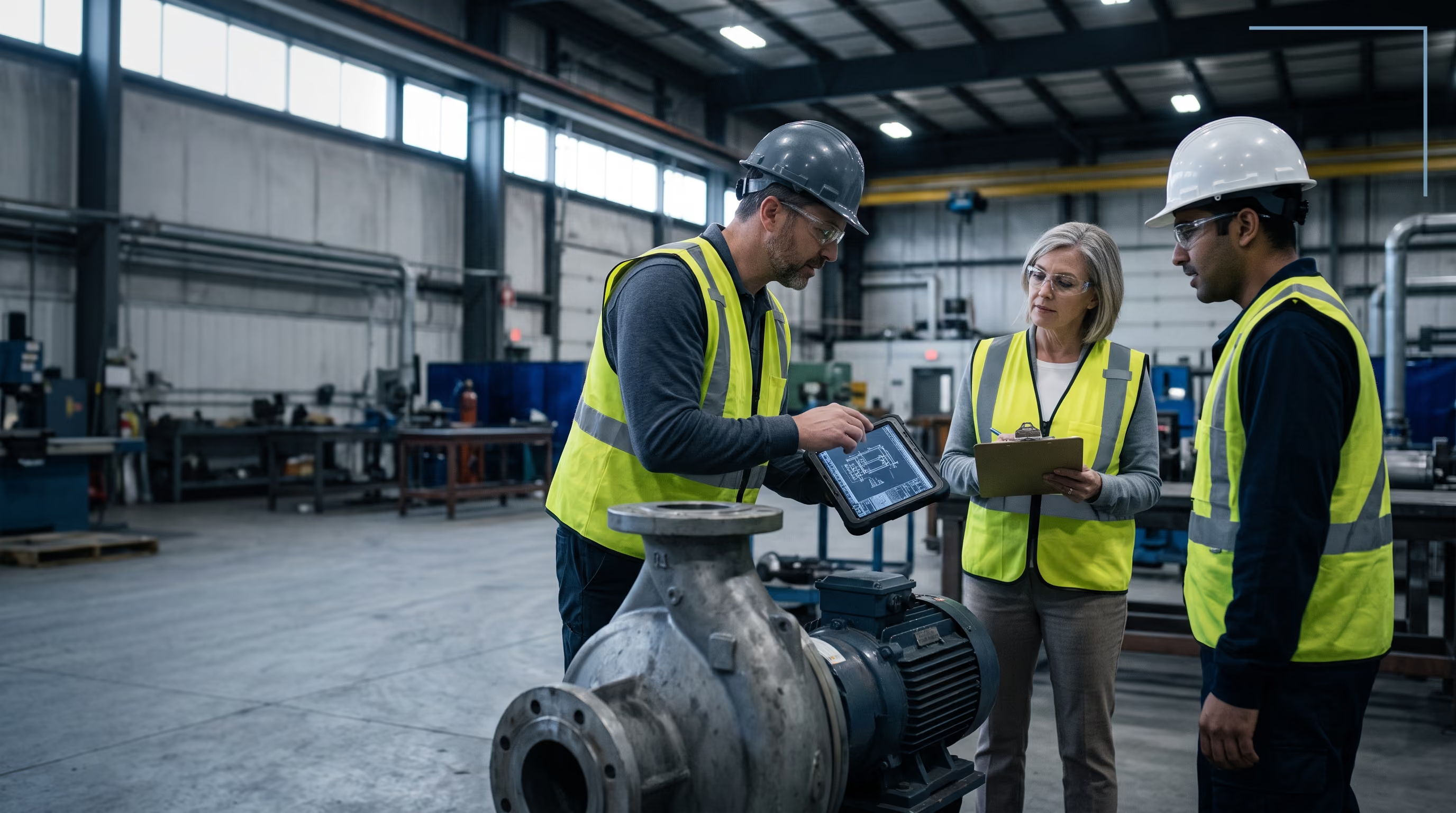

Industrial buyers rarely decide alone, rarely decide quickly and rarely rely on what a supplier says about itself. A purchase is usually made by a group of people with different roles, over a process that can last months or years, against technical and financial criteria. Much of the research now happens online before a supplier is contacted, buyers lean heavily on references and colleagues' advice, and emotions play a part at every stage. The journey also continues after the order, into installation and use. Each of these facts changes how an industrial company should market.
How research on industrial buying has changed
Academic work on B2B buying goes back to the 1950s. Reviewing that history, Steward and colleagues (2019) found it has moved in waves through seven themes: transactions, situations, influences, responses, relationships, networks and journeys. Early models treated a purchase as a single transaction. Later work looked at how the type of purchase changes the process, who influences it, how suppliers respond, and how buyers and suppliers build relationships and networks. The current wave treats buying as a journey made up of many touchpoints.
Sheth (1996), reviewing two decades of research after his own model of industrial buying, concluded that purchasing was shifting from a transaction-oriented to a relationship-oriented philosophy, and from domestic to global sourcing. Both shifts still shape industrial markets.
What shapes an industrial purchase
1. Demand is derived and criteria are explicit
Organizations buy to meet the needs of their own customers. Grewal and colleagues (2015) point out that impulse buying is rare in B2B. Choices are driven by clearly stated, objective criteria, such as meeting production needs and schedules at minimum cost.
For marketing: Lead with the criteria buyers already use. Specifications, tolerances, lead times, total cost of ownership and compliance are the vocabulary of the decision. Marketing that avoids them sounds evasive to a technical buyer.
2. A group decides, and its makeup changes
More than one person is involved, and a purchasing manager rarely decides independently of other stakeholders (Grewal et al., 2015). Researchers call this group the buying center. Johnston and Bonoma (1981) studied capital equipment and industrial service purchases in 31 firms and found that organizational structure and the attributes of the purchase situation correlated with the dimensions of the buying group.
How much the purchase situation shapes the group is less settled than marketing books suggest. Lewin and Donthu (2005) ran a meta-analysis of the research linking purchase situations to buying-center structure and involvement. Some findings held up across studies; others did not, and differences in how the studies were designed explained much of the variation.
The group is also getting wider. Ehret, Johnston and Ritter (2024) argue that buying centers are becoming buying ecosystems: information technology is moving from something being purchased to an AI-enabled agent in the buying process, servitization is raising the importance of users, public actors are taking more active roles, and sustainability goals are changing who sits in the group and what they are responsible for.
For marketing: Don't assume you know who decides. Map the buying center for each type of deal, and make sure your content serves the engineer, the operations lead, the finance approver and the purchasing manager. See our guide to the buying center.
3. The process is long, iterative and continues after the sale
High dollar values, multiple stakeholders and technical complexity make the process long. It can take months or years and involve extensive negotiation (Grewal et al., 2015).
Purmonen, Jaakkola and Terho (2023) synthesized research on customer journeys, purchase processes, buying centers and relationships to define the B2B customer journey. Their framework gives equal weight to the purchase stage and the usage stage, includes both buying-center and usage-center members, and treats the journey as iterative and embedded in ongoing relationships.
Digital tools are reshaping that journey. In a case study of a B2B firm and four of its customers, Lundin and Kindström (2023) identified three ways digitalization changes B2B journeys: it adds and transforms touchpoints, it changes roles (introducing new ones, activating customers and emphasizing collective work), and it extends and supports the overall process.
For marketing: Plan content and contact for the whole journey, including onboarding and use. The people using your product after installation are the source of your next reference and your next order.
4. Buyers research before they call
Marvasti and colleagues (2021) note that B2B buyers now carry out over half of the buying process through digital touchpoints before they make significant contact with a seller. Their study showed that a company's online browsing behavior can be used to estimate which stage of the buying journey it has reached.
For marketing: Your website, technical content and search presence are the first sales conversations. If they don't answer the buyer's questions, you may never learn the buyer existed. See SEO for manufacturers and what makes a B2B website work for industrial buyers.
5. Buyers trust experience-based information
In complex purchases, buyers try to gather the experience scattered around their business network. Aarikka-Stenroos and Makkonen (2014) studied eight cases of buyers purchasing knowledge-intensive services and technology innovations. They found buyers use customer references, word of mouth, collegial advice networks and reputation as sources of experience-based information, and that this information tells them about the offering, the supplier and the problem-solving situation itself.
For marketing: Make references easy to find and easy to verify. Case studies, named customers, site visits and introductions to existing users carry weight that brochures do not. See case studies and references.
6. Emotions are part of the decision
Organizational buying is often described as purely rational. Kemp and colleagues (2018) interviewed marketing decision-makers at one of the world's most valuable brands and found that emotions are present at all stages of the organizational decision-making process, and that specific emotions drive what buyers do next. Buyers still need to see functional value, but brands also need to connect with them on an emotional and personal level.
For marketing: The emotion that matters most in industrial buying is often the fear of making a costly mistake. Content that reduces that fear (proof, guarantees, references, clear implementation plans) is doing emotional work as well as rational work.
What this means for industrial marketing
- Groups decide → create content for each role in the buying center, not one generic brochure.
- Long journeys → plan for months of nurturing and stay present after the sale.
- Online research first → treat the website and search presence as the opening sales meeting.
- Experience-based information → build a reference program and publish specific case studies.
- Emotion and risk → make proof of reliability visible everywhere.
- Wider buying ecosystems → expect sustainability, users and, increasingly, AI tools to influence decisions.
How to map your buyers' journey
- Pick one deal type. For example, a first purchase of a new piece of equipment by a mid-sized manufacturer.
- List everyone involved. Ask your sales team who appeared in the last five deals of that type, including people who joined late.
- Write each person's main question. The engineer asks "Will it work?" Finance asks "What does it cost over its life?" Operations asks "What happens during installation?"
- Trace where they look. Search, your website, distributors, trade shows, peers, industry forums.
- Find the gaps. Which questions have no good answer on your website or in your sales materials?
- Fill the biggest gap first. Then repeat for the next deal type.
Frequently asked questions
What are the stages of the B2B buying process?
Models differ, but most include recognizing a need, defining requirements, searching for suppliers, evaluating options, selecting a supplier, and using and reviewing the purchase. Recent research treats these stages as iterative rather than strictly sequential, and includes the usage stage as part of the journey (Purmonen et al., 2023).
How is industrial buying different from consumer buying?
Industrial buying satisfies derived demand, involves several people, uses explicit and often technical criteria, and usually takes much longer because of high values and complexity (Grewal et al., 2015).
How many people are involved in an industrial purchase?
It varies with the purchase. Research links the size and structure of the buying group to the purchase situation and the buying organization's structure (Johnston & Bonoma, 1981), but the evidence on exactly how is mixed (Lewin & Donthu, 2005). Map it deal by deal.
Do emotions really matter in B2B buying?
Yes. Research with marketing decision-makers found emotions present at every stage of organizational buying (Kemp et al., 2018). In industrial markets, the strongest emotion is often the fear of a costly mistake.
The bottom line
Before your next campaign, map one buyer journey with your sales team and fix the biggest unanswered question you find. That single step usually improves marketing more than any new channel. If you want help, book a strategy call.
About the author
Mo Farrokhi, PhD, is the founder of AXXEN in Calgary, Alberta. His path runs from electrical engineering through an MBA and a PhD in marketing to industry roles, including VP Marketing & Product at a TSX-listed clean-tech company. AXXEN builds marketing systems for technology, manufacturing and industrial companies that have outgrown ad-hoc marketing.
Sources
- Aarikka-Stenroos, L., & Makkonen, H. S. (2014). Industrial buyers' use of references, word-of-mouth and reputation in complex buying situation. Journal of Business & Industrial Marketing, 29(4), 344–352. https://doi.org/10.1108/jbim-08-2013-0164
- Ehret, M., Johnston, W. J., & Ritter, T. (2024). From buying centers to buying ecosystems: Advancing the B2B research journey. Industrial Marketing Management, 117, A10–A16. https://doi.org/10.1016/j.indmarman.2023.12.020
- Grewal, R., Lilien, G. L., Bharadwaj, S., Jindal, P., Kayande, U., Lusch, R. F., Mantrala, M., Palmatier, R. W., Rindfleisch, A., Scheer, L. K., Spekman, R., & Sridhar, S. (2015). Business-to-business buying: Challenges and opportunities. Customer Needs and Solutions, 2(3), 193–208. https://doi.org/10.1007/s40547-015-0040-5
- Johnston, W. J., & Bonoma, T. V. (1981). The buying center: Structure and interaction patterns. Journal of Marketing, 45(3), 143–156. https://doi.org/10.1177/002224298104500312
- Kemp, E. A., Borders, A. L., Anaza, N. A., & Johnston, W. J. (2018). The heart in organizational buying: Marketers' understanding of emotions and decision-making of buyers. Journal of Business & Industrial Marketing, 33(1), 19–28. https://doi.org/10.1108/jbim-06-2017-0129
- Lewin, J. E., & Donthu, N. (2005). The influence of purchase situation on buying center structure and involvement: A select meta-analysis of organizational buying behavior research. Journal of Business Research, 58(10), 1381–1390. https://doi.org/10.1016/j.jbusres.2004.09.004
- Lundin, L., & Kindström, D. (2023). Digitalizing customer journeys in B2B markets. Journal of Business Research, 157, 113639. https://doi.org/10.1016/j.jbusres.2022.113639
- Marvasti, N. B., Huhtala, J. P., Yousefi, Z. R., Vaniala, I., Upreti, B., Malo, P., Kaski, S., & Tikkanen, H. (2021). Is this company a lead customer? Estimating stages of B2B buying journey. Industrial Marketing Management, 97, 126–133. https://doi.org/10.1016/j.indmarman.2021.06.003
- Purmonen, A., Jaakkola, E., & Terho, H. (2023). B2B customer journeys: Conceptualization and an integrative framework. Industrial Marketing Management, 113, 74–87. https://doi.org/10.1016/j.indmarman.2023.05.020
- Sheth, J. N. (1996). Organizational buying behavior: Past performance and future expectations. Journal of Business & Industrial Marketing, 11(3/4), 7–24. https://doi.org/10.1108/08858629610125441
- Steward, M. D., Narus, J. A., Roehm, M. L., & Ritz, W. (2019). From transactions to journeys and beyond: The evolution of B2B buying process modeling. Industrial Marketing Management, 83, 288–300. https://doi.org/10.1016/j.indmarman.2019.05.002