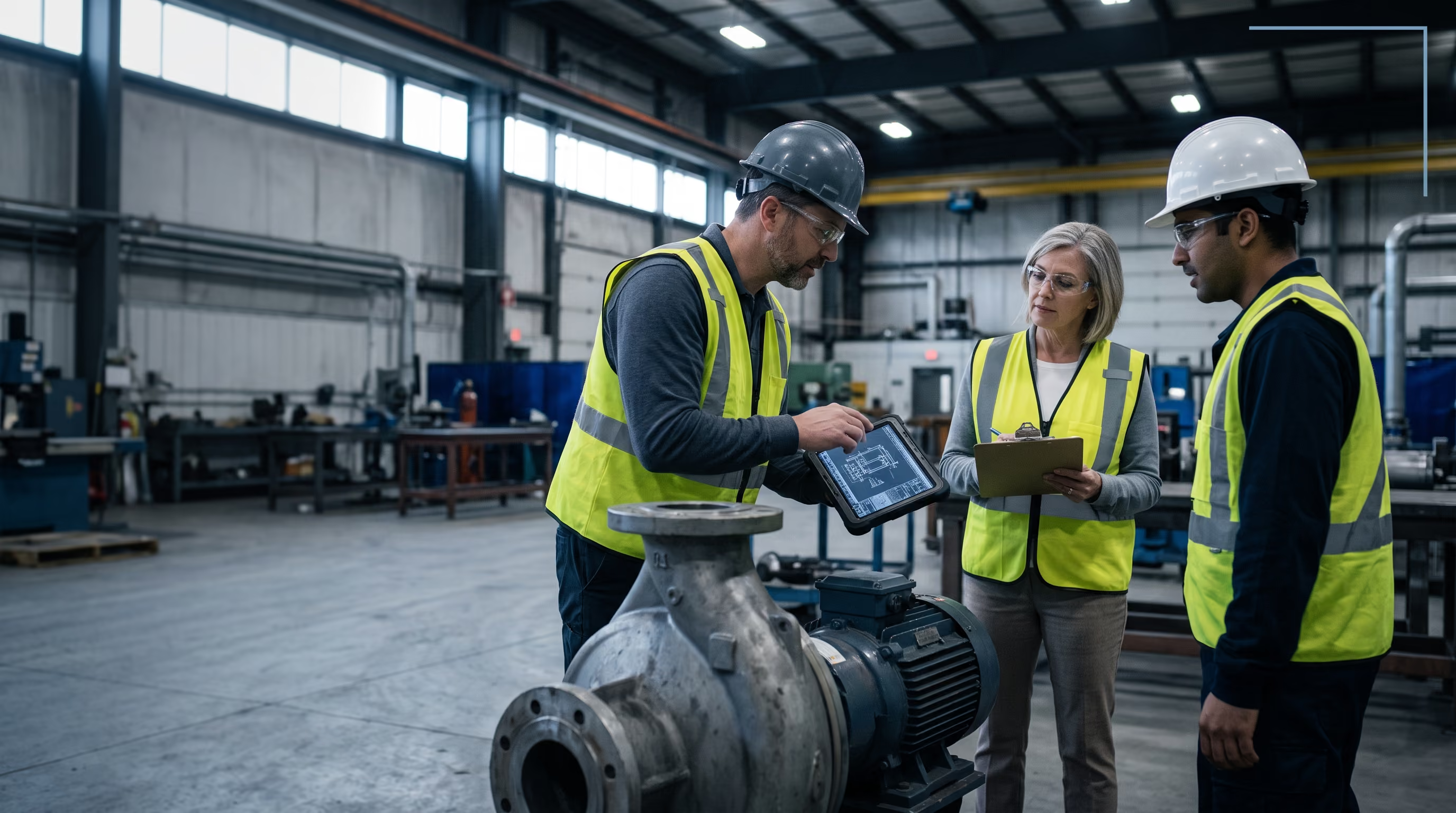
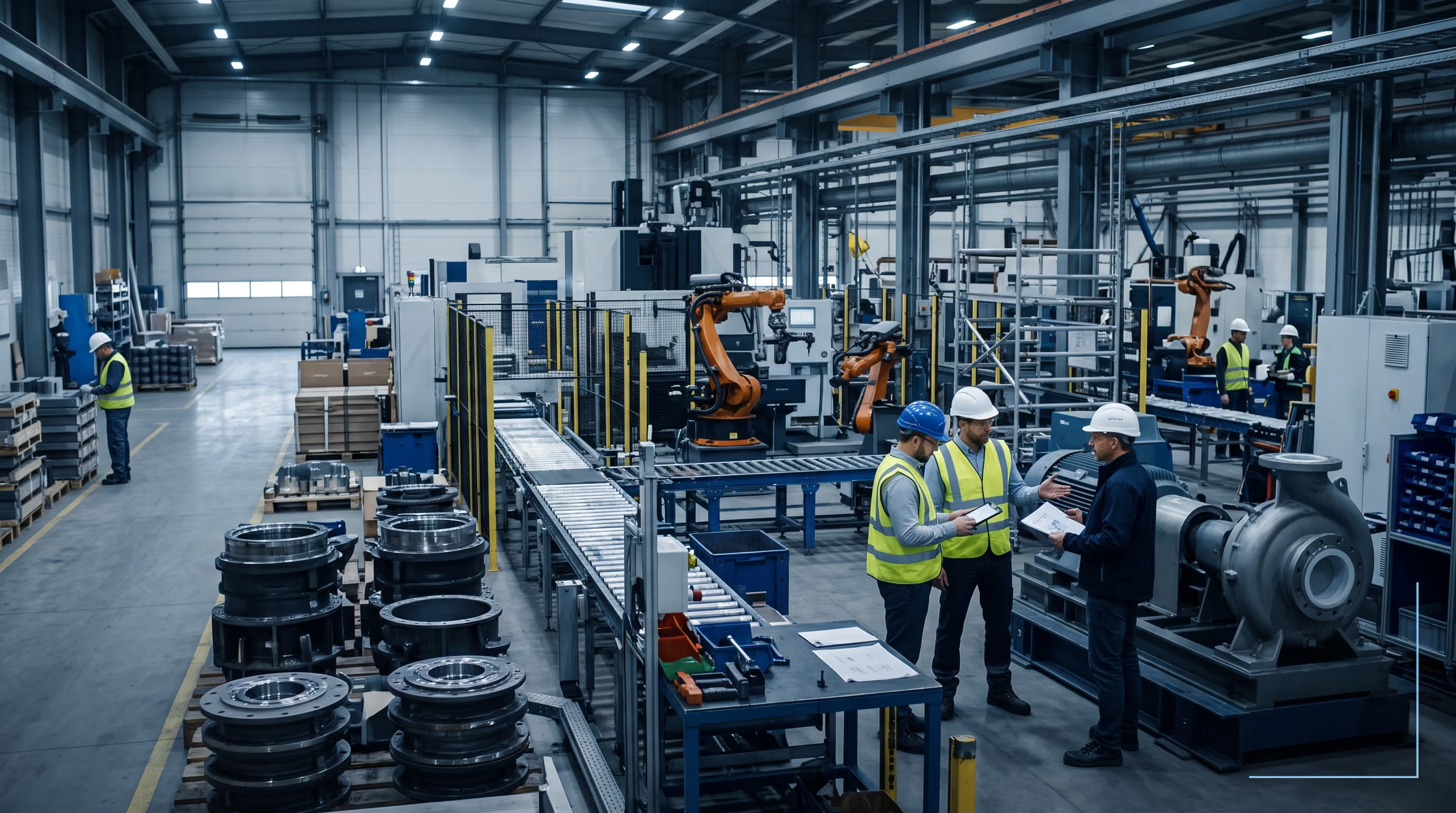
Industrial marketing is the marketing of products and services to organizations that use them to make other products, run their operations or maintain their facilities. Examples include machinery, components, raw and processed materials, engineering and maintenance services, and industrial software. It is a part of business-to-business (B2B) marketing, focused on companies that sell into manufacturing, energy, construction, transportation and similar sectors. Because the buyer is an organization, industrial marketing deals with group decisions, technical criteria, long buying cycles and lasting supplier relationships.
A simple definition
Industrial marketing is how a company that sells to industry creates demand for its offering, positions it against alternatives and supports the people who decide to buy it. The customer is not a consumer buying for personal use. It is an organization buying to produce, operate or resell.
Typical industrial offerings include:
- Capital equipment such as presses, compressors, pumps and production lines
- Components and parts built into another company's product
- Materials, from steel and resins to specialty chemicals
- Engineering, fabrication, installation and maintenance services
- Industrial technology, including automation, sensors, controls and software
Industrial marketing vs. B2B marketing vs. consumer marketing
All industrial marketing is B2B marketing, but not all B2B marketing is industrial. A payroll software company selling to law firms is B2B; a company selling hydraulic cylinders to equipment manufacturers is both B2B and industrial. The distinction matters because industrial buying has its own features.
Grewal and colleagues (2015) describe four ways B2B buying differs from consumer buying, and each is especially strong in industrial markets:
- Derived demand. Organizations buy to meet the needs of their own customers. Impulse buying is rare, and choices follow stated, objective criteria such as production needs, schedules and cost.
- More than one decision-maker. Purchasing managers rarely decide without input from other stakeholders inside and outside the organization.
- Long, negotiated processes. High dollar values, many stakeholders and technical complexity can stretch the process over months or years.
- Hard-to-trace cause and effect. Because so many people and steps are involved, it is difficult to connect a specific marketing effort to a specific buyer response.
What industrial marketers actually do
Day to day, industrial marketing covers:
- Positioning and value propositions. Defining which customers to serve and why they should choose you over alternatives.
- Technical content. Application notes, specification sheets, case studies and guides that answer engineers' and buyers' questions.
- Websites and search. Making sure buyers who search for a problem, capability or specification find you.
- Trade shows and events. Meeting buyers and showing equipment in person.
- Sales enablement. Giving the sales team proposals, presentations and proof that move deals forward.
- Customer references. Turning satisfied customers into evidence that persuades new ones.
- Brand. Making the company look and sound as capable as it is.
Why industrial marketing is changing
Two long-running shifts define the field.
From transactions to relationships. Reviewing the research on organizational buying, Sheth (1996) concluded that purchasing was moving from a transaction-oriented philosophy to a relationship-oriented one, and from domestic to global sourcing. Industrial marketing has followed, with more emphasis on long-term accounts, service and partnership.
From sales calls to digital journeys. Academic models of B2B buying have moved from transactions to relationships, networks and now customer journeys (Steward et al., 2019). Marvasti and colleagues (2021) note that B2B buyers now carry out over half of the buying process through digital touchpoints before significant contact with a seller. For industrial companies, the website and search presence now do much of the early work that sales visits used to do. For a deeper look, see how industrial buyers actually buy.
A common misconception: industrial buyers are purely rational
Industrial buyers are trained to evaluate specifications and costs, so it is tempting to think emotion plays no role. The research disagrees. Kemp and colleagues (2018) found that emotions are present at every stage of organizational buying. Leek and Christodoulides (2012) found that industrial brand equity rests on functional qualities such as quality, technology and reliability, and on emotional qualities such as risk reduction, reassurance and trust.
In practice, the emotion that drives most industrial decisions is the wish to avoid a costly mistake. Good industrial marketing addresses it directly with proof, references and clear implementation plans.
Frequently asked questions
Is industrial marketing the same as B2B marketing?
Industrial marketing is a subset of B2B marketing. It focuses on companies that sell products and services used in manufacturing, operations and infrastructure. B2B marketing also includes sectors such as professional services and business software.
What are examples of industrial marketing?
A valve manufacturer publishing application guides for process engineers, a fabrication shop showing case studies of complex builds, an automation company exhibiting at a manufacturing trade show, and an industrial distributor building a searchable product catalogue are all examples of industrial marketing.
What is the difference between industrial and consumer marketing?
Consumer marketing targets individuals buying for personal use, often quickly and with one decision-maker. Industrial marketing targets organizations, where several people decide over a longer process using technical and financial criteria (Grewal et al., 2015).
Why is industrial marketing important?
Industrial buyers now do much of their research online before they contact suppliers (Marvasti et al., 2021). A company with strong engineering but weak marketing may never make the shortlist, because the buyer never found it or didn't trust what they found.
The bottom line
If your company sells to industry, your marketing has to work for engineers, operators, finance and procurement at once. Start by reading our B2B marketing strategy playbook for industrial companies.
About the author
Mo Farrokhi, PhD, is the founder of AXXEN in Calgary, Alberta. His path runs from electrical engineering through an MBA and a PhD in marketing to industry roles, including VP Marketing & Product at a TSX-listed clean-tech company. AXXEN builds marketing systems for technology, manufacturing and industrial companies that have outgrown ad-hoc marketing.
Sources
- Grewal, R., Lilien, G. L., Bharadwaj, S., Jindal, P., Kayande, U., Lusch, R. F., Mantrala, M., Palmatier, R. W., Rindfleisch, A., Scheer, L. K., Spekman, R., & Sridhar, S. (2015). Business-to-business buying: Challenges and opportunities. Customer Needs and Solutions, 2(3), 193–208. https://doi.org/10.1007/s40547-015-0040-5
- Kemp, E. A., Borders, A. L., Anaza, N. A., & Johnston, W. J. (2018). The heart in organizational buying: Marketers' understanding of emotions and decision-making of buyers. Journal of Business & Industrial Marketing, 33(1), 19–28. https://doi.org/10.1108/jbim-06-2017-0129
- Leek, S., & Christodoulides, G. (2012). A framework of brand value in B2B markets: The contributing role of functional and emotional components. Industrial Marketing Management, 41(1), 106–114. https://doi.org/10.1016/j.indmarman.2011.11.009
- Marvasti, N. B., Huhtala, J. P., Yousefi, Z. R., Vaniala, I., Upreti, B., Malo, P., Kaski, S., & Tikkanen, H. (2021). Is this company a lead customer? Estimating stages of B2B buying journey. Industrial Marketing Management, 97, 126–133. https://doi.org/10.1016/j.indmarman.2021.06.003
- Sheth, J. N. (1996). Organizational buying behavior: Past performance and future expectations. Journal of Business & Industrial Marketing, 11(3/4), 7–24. https://doi.org/10.1108/08858629610125441
- Steward, M. D., Narus, J. A., Roehm, M. L., & Ritz, W. (2019). From transactions to journeys and beyond: The evolution of B2B buying process modeling. Industrial Marketing Management, 83, 288–300. https://doi.org/10.1016/j.indmarman.2019.05.002